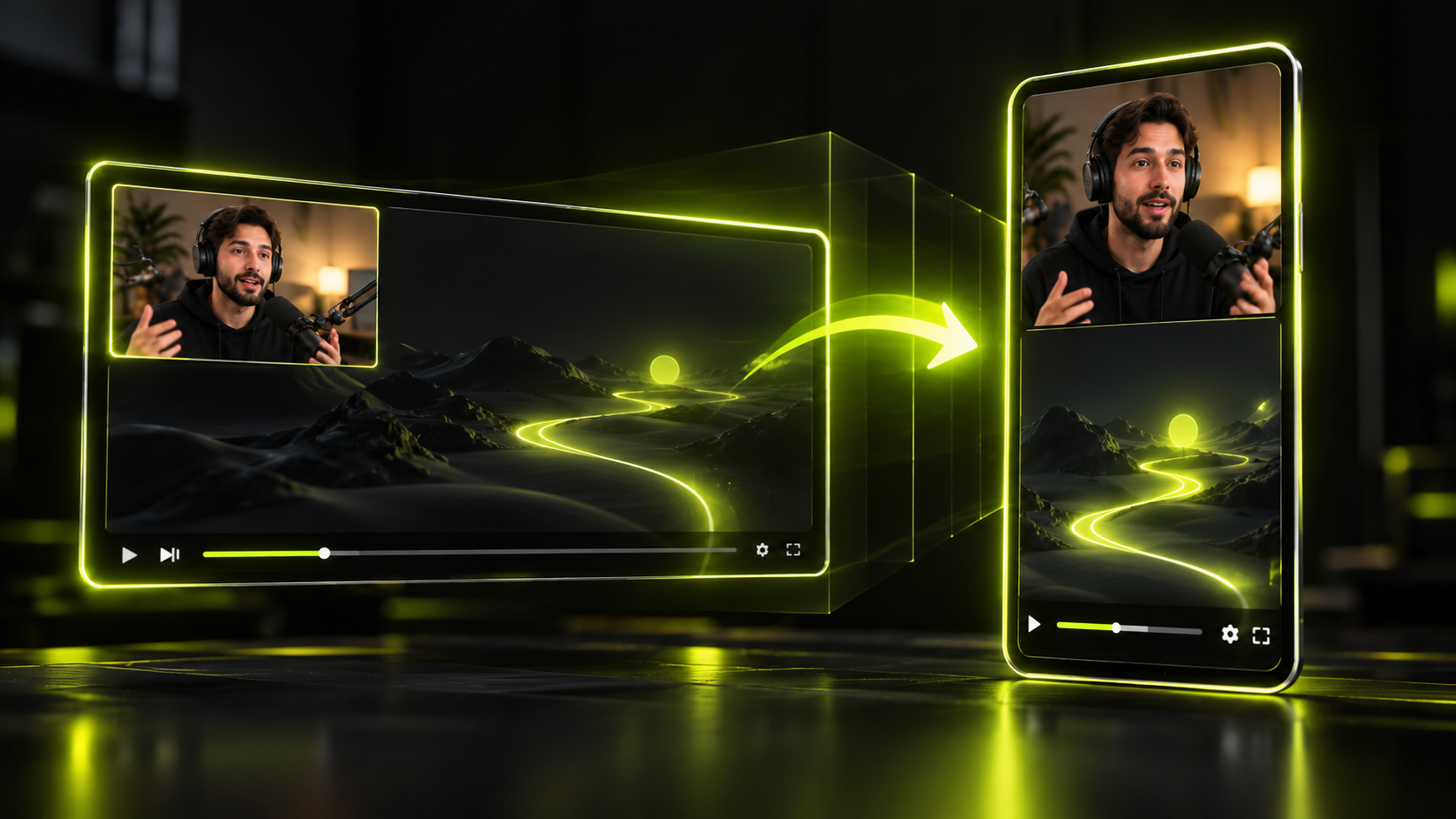
The best hook examples for shorts cut from long videos aren't lines you write. They're lines someone already said, sitting somewhere in your transcript. This list gives you 50 of them. They're sorted into seven types: question, contrarian, number, payoff-first, story mid-point, confession and stakes, and text-overlay rescue.
Most hook lists assume you can re-film the opening. Podcasts, streams, webinars and talks don't give you that option. So each group below also shows how to spot the pattern in footage you already have. Every example is an illustration of a pattern, not a quote from a real person.
The short version
- For clips from long videos, you find the hook rather than write it. Look for a line that makes sense with no setup.
- This list sorts usable openings into seven patterns: question, contrarian, number, payoff-first, story mid-point, confession or stakes, and text overlay.
- Curiosity research supports opening with a gap, but it comes from lab studies with trivia, not short video feeds.
- Start the clip on the hook's first word and cut the warm-up before it.
- When the spoken opening is slow, a short on-screen text line can carry the first seconds.
- None of these patterns depend on one platform, so use them for Shorts, TikTok or Reels.
Why hooks work, and what the research doesn't prove
Platforms measure the opening of a short, so the first line carries real weight. Instagram tells creators to "make sure the first 3 seconds of your reel are engaging." Its View Rate metric shows how many viewers keep watching past those 3 seconds.
YouTube measures the same moment in its own terms. One Shorts lead put it this way: "instead of impression and click-through, you have view vs swiped away." YouTube doesn't publish a hook length or a seconds threshold.
Creators push the window even shorter. Creator Jenny Hoyos, quoted on the YouTube Blog, says "you have one second to hook someone, especially on Shorts." Makeup creator Sydney Morgan says the first 3 seconds should be "thumb-stopping" and make clear what viewers are about to watch. Treat both as creator advice, not platform rules.
Curiosity research offers a likely reason that questions and open gaps work, with limits. George Loewenstein's information-gap theory says curiosity arises when attention lands on a gap in what you know. Brod and Breitwieser summarized it in a 2019 paper.
In a 2009 lab study, Kang and colleagues asked people trivia questions. Curiosity about a question went along with activity in reward-related brain areas. Curious participants also spent scarce tokens or waiting time to learn the answers. Higher curiosity went with better recall of surprising answers one to two weeks later.
Brod and Breitwieser also found that making a prediction raised curiosity more than being given an example. That's a good argument for hooks that invite a guess. Still, these are lab studies about trivia, not shorts in a feed. They support using gaps and questions, but they don't show that any hook will lift your views.
For what each platform measures in the opening, see the first 3 seconds: how to hook a short.
How to use this list
Use these lines as search patterns, not scripts. Your guest won't say example 12 word for word. They'll say something with the same shape, and your job is to recognize it.
Run three checks on any line you find:
- It makes sense with no setup. A stranger can follow it cold.
- It starts the clip. The first word on screen is the first word of the hook.
- The rest of the clip pays it off. A question needs its answer, and a claim needs its reason.
Getting the start point right is its own skill, covered in how to pick the first word of a clip. Skip any hook the clip doesn't deliver, since a bait opening makes a promise the clip then breaks. If you clip other creators, get permission or work through a clipping program first.
In Hookspring, each clip candidate from Magic Clips gets a hook score with a plain-English reason, based on its opening 1 to 3 seconds. Sort the review list by score, then read each reason next to the patterns below. A high score is a starting point for your review, not a promise of views.
Question hooks
Look for lines that end in a question mark, then check that the answer lands inside the clip. Lines that invite the viewer to guess fit the prediction finding above.
- "Why does every new podcast sound the same for its first year?" (illustration)
- "What would you cut first if your budget vanished tomorrow?" (illustration)
- "Why did the video I spent a month on get the fewest views?" (illustration)
- "Can you guess which item customers returned the most?" (illustration)
- "Do you know what a recruiter reads first on a resume?" (illustration)
- "What happens to a stream when the chat goes quiet?" (illustration)
- "Is it ever worth quitting a job before you have the next one?" (illustration)
- "Which would you pick: more money, or two free hours a day?" (illustration)
Contrarian hooks
Scan for words like "actually," "everyone says," "I disagree" and "stop." Start the cut on the claim itself, not on the "I know this sounds weird, but" before it.
- "Posting every day made my channel worse, not better." (illustration)
- "Most advice about morning routines is backwards." (illustration)
- "Stop asking your friends for feedback." (illustration)
- "Everyone says niche down. I think that's wrong for beginners." (illustration)
- "The expensive microphone was the worst thing I bought." (illustration)
- "Your first hire shouldn't be an assistant." (illustration)
- "I don't think talent matters as much as people say." (illustration)
- "Boring cold emails get more replies than clever ones." (illustration)
Number hooks
Digits and number words stand out in a transcript: "three things," "two mistakes," "48 hours." Check that the clip delivers every item the number promises.
- "Three things I'd never do again with a product launch." (illustration)
- "I made two mistakes in my first year, and both cost money." (illustration)
- "It took 400 cold emails to get one reply." (illustration)
- "Ten years of teaching, and one lesson keeps coming back." (illustration)
- "Only two questions really matter in an interview." (illustration)
- "We had 48 hours to fix the whole show." (illustration)
- "Five seconds. That's how long I had to answer." (illustration)
Payoff-first hooks
Find the result line, often near the end of a story: "and that's how," "it worked," "we sold out." Move it to the front of the clip, then let the setup play after it.
- "And that's when the whole room went silent." (illustration)
- "We sold out in a day, and here's what we changed." (illustration)
- "The answer turned out to be one setting on the camera." (illustration)
- "It worked. The client signed the next morning." (illustration)
- "That one line got me the job." (illustration)
- "In the end, the bug was a single missing comma." (illustration)
- "So we tried the opposite, and it finally worked." (illustration)
Story mid-point hooks
Look for scene-setting phrases like "so I'm standing there," "that's when" and "then my phone rings," often in present tense. Start at the moment things change, and drop the background that leads up to it.
- "So I'm standing on stage, and the slides won't load." (illustration)
- "Halfway through the call, he just stops talking." (illustration)
- "The tire blew out right as we hit the bridge." (illustration)
- "Then my phone rings, and it's the landlord." (illustration)
- "Three minutes left, and our best player disconnects." (illustration)
- "She opens the box, looks at me, and laughs." (illustration)
- "The door's locked, the clock's running, and nobody has the key." (illustration)
Confession and stakes hooks
Watch for "I've never told anyone," "honestly," "I was wrong" and "I almost." These lines put something personal at risk, so check the speaker is fine with it as a standalone clip.
- "I've never said this on the show before." (illustration)
- "Honestly, I almost quit the week before it took off." (illustration)
- "I was completely wrong about this for five years." (illustration)
- "If this demo fails, the company's done." (illustration)
- "I lost my biggest client with one email." (illustration)
- "This is the part I'm still embarrassed about." (illustration)
- "We had one shot, and I'd already spent the budget." (illustration)
Text-overlay rescue hooks
Use this when the best moment opens with "so, um" or a long setup and no clean line exists. Write a short on-screen line that names the payoff, and only promise what the clip shows.
- "He lost the deal in one sentence" (illustration, on-screen text)
- "Watch her face at the end" (illustration, on-screen text)
- "The worst advice she ever got" (illustration, on-screen text)
- "One setting fixed his audio" (illustration, on-screen text)
- "Wait for the chat's reaction" (illustration, on-screen text)
- "The question that ended the interview" (illustration, on-screen text)
How to find these patterns in a transcript
Skim the transcript instead of scrubbing the video. Mark every line that passes the no-setup test, note its pattern, and keep the strongest one or two per type.
| Pattern | Cue words to look for | Where the clip starts |
|---|---|---|
| Question | A question mark with the answer close behind | On the question |
| Contrarian | "actually," "everyone says," "stop" | On the claim |
| Number | Digits, "three things," "two mistakes" | On the number |
| Payoff-first | "it worked," "that's how," "we sold out" | On the result, moved to the front |
| Story mid-point | "so I'm standing there," "that's when" | At the moment things change |
| Confession or stakes | "honestly," "I've never told," "I almost" | On the admission |
| Text-overlay rescue | Slow "so, um" openings | Same start, with text over the first seconds |
Here's a short worked example. It's an illustration, not a real transcript.
"So, um, before we get into it, I've been doing this about ten years. Honestly, I almost quit the week before it took off."
The first sentence is setup. The second is a confession hook, so the clip should open on "Honestly." If the rest of the clip explains why they almost quit, you have a short.
In Hookspring, open Editor → Captions and use ✂ on a line to cut from the transcript. Every word is timestamped, so you can see exactly where "Honestly" begins. Then fine-tune the start with the timeline handles.
Payoff-first hooks need one extra step. Split the clip on the timeline, then reorder the pieces so the result plays first. Keep the meaning intact, since a reordered clip shouldn't change what the speaker said.
For a slow opening, add a line from the Editor toolbar → Text and keep it short enough to read in the first seconds. Wording, placement and safe zones are covered in on-screen text hooks for shorts.
Starting from an idea instead of footage? The same seven patterns work as written first lines. See how to write a 45-second Shorts script.
FAQ
What is a good hook for Shorts?
A good hook is a line or image that makes sense with no setup and gives a stranger a reason to stay. For clips, it's often a question, claim, number, result or story moment already in your footage.
How long should a hook be?
Neither YouTube nor Instagram publishes a required hook length. Instagram reports View Rate past 3 seconds, and YouTube reports viewed vs swiped away without a seconds threshold. A practical aim is to land the hook within the first few seconds. Hookspring's hook score looks at the opening 1 to 3 seconds.
Do text overlay hooks matter?
Use them when the spoken opening is slow and you can't re-film it. A short on-screen line can name the payoff while the speaker warms up. Keep it honest: the clip has to deliver what the text promises.
Should you use the same hook formula every time?
We'd suggest rotating types. Try a few patterns across your next batch of clips. Then compare viewed vs swiped away or View Rate against your own recent shorts, since no official benchmark says which type wins.
How do you find a hook in a long video?
Skim the transcript for the cue words in the table above, then mark lines that make sense with no setup. Cut each clip so it opens on the hook's first word. Hookspring ranks clip candidates by hook score with a reason, which gives you a sorted shortlist to check.
Written and maintained by the Hookspring team. Spot an error or something out of date? Email hello@hookspring.com.
Sources
- How Sydney Morgan creates the smoothest makeup transformations, YouTube Blog, retrieved 2026-10-18
- The Wick in the Candle of Learning (Kang et al., 2009, Psychological Science), Caltech Authors, retrieved 2026-10-18
- Brod and Breitwieser (2019), npj Science of Learning, PubMed Central, retrieved 2026-10-18
- Creators FAQ, Instagram, retrieved 2026-10-18
- Helping creators of all sizes break through, Instagram, retrieved 2026-10-18
- Rene's top five, March 4, 2024, YouTube Blog, retrieved 2026-10-18
- YouTube Shorts deep dive, YouTube Blog, retrieved 2026-10-18